The Lobster à l'américaine Story
We are now nearly fully sure of the validity of the "à l'américaine" name of this recipe, to the contrary of the "à l'armoricaine" one (note of the translator : "armoricaine" means "from Armorique" and "Armorique" is the old name for Brittany, this west region of France where fish and seafood are so famous and so "armoricain(e)" means "from Brittany". The confusion for the name of this recipe comes from the fact that it could be logic that such a lobster recipe is from Brittany where the best blue lobsters are fished).
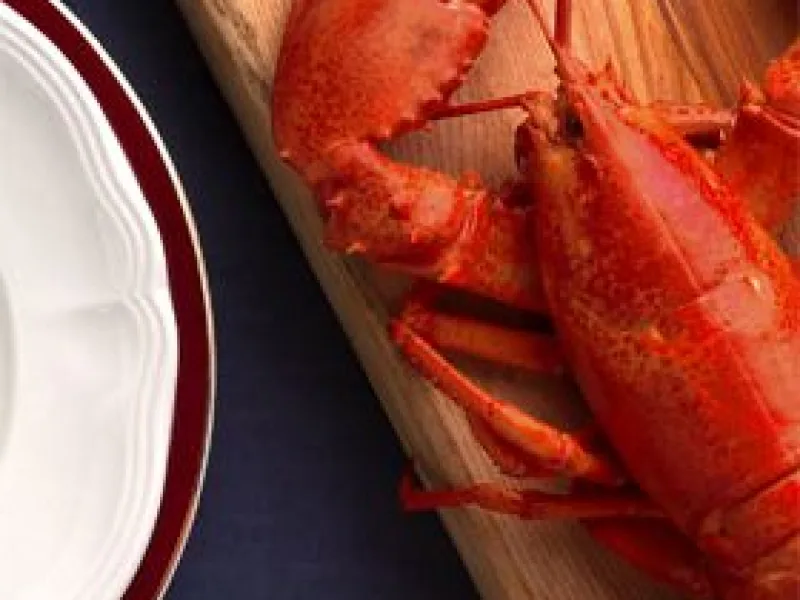
We even know where and when this recipe was created. This is then the comical story of the "(blue) lobster à l'américaine" (note of the translator : in French language, the blue or brown lobster - the one with the strong claws - is called "homard" and the red spiny lobster - the one with no claws - is called "langouste").
This recipe was created in the 1860s by Pierre Fraise, a French cook from Sète (note of the translator : south of France, on the sea coast, close to Montpellier, between Marseille and the Spanish boarder).
Back to France after a long stay in the USA, he settled his own business in Paris. He first called his restaurant "Peter" and thereafter "Peter's". Success came immediatly.
One evening, quite late, a few diners came into the restaurant. Pierre was really confused because his fridges were empty to allow him to prepare a meal except, maybe, a few lobsters forecasted to be cooked the day after.
So, no other alternative : he has to speed up : he cuts the lobsters alive, sauté them quickly into little olive oil, flambé them with fine Cognac brandy and throw them onto some chopped shallots, fresh tomatoes, shopped garlic, then he pours one bottle of white wine, seasons with salt and black pepper and cook the whole very quickly.
He presents the lobster pieces and the sauce onto a long dish, comes into the diner room and proudly (sic) announces, still under the influence of his US trip : "ladies and gentlemen, here is my most recent creation ; I called it "Lobster à l'américaine". It was the first time such recipe name was worded.
Much later, the prestigious chef Prosper Montagné and other famous chefs, including the one of the most famous restaurant at that time (Larue restaurant) rejected in whole this innovative recipe.
But finally, who cares since this recipe is now still a symbolic part of the quality of the French cuisine.
And now is the recipe of Lobster à l'américaine.
We even know where and when this recipe was created. This is then the comical story of the "(blue) lobster à l'américaine" (note of the translator : in French language, the blue or brown lobster - the one with the strong claws - is called "homard" and the red spiny lobster - the one with no claws - is called "langouste").
This recipe was created in the 1860s by Pierre Fraise, a French cook from Sète (note of the translator : south of France, on the sea coast, close to Montpellier, between Marseille and the Spanish boarder).
Back to France after a long stay in the USA, he settled his own business in Paris. He first called his restaurant "Peter" and thereafter "Peter's". Success came immediatly.
One evening, quite late, a few diners came into the restaurant. Pierre was really confused because his fridges were empty to allow him to prepare a meal except, maybe, a few lobsters forecasted to be cooked the day after.
So, no other alternative : he has to speed up : he cuts the lobsters alive, sauté them quickly into little olive oil, flambé them with fine Cognac brandy and throw them onto some chopped shallots, fresh tomatoes, shopped garlic, then he pours one bottle of white wine, seasons with salt and black pepper and cook the whole very quickly.
He presents the lobster pieces and the sauce onto a long dish, comes into the diner room and proudly (sic) announces, still under the influence of his US trip : "ladies and gentlemen, here is my most recent creation ; I called it "Lobster à l'américaine". It was the first time such recipe name was worded.
Much later, the prestigious chef Prosper Montagné and other famous chefs, including the one of the most famous restaurant at that time (Larue restaurant) rejected in whole this innovative recipe.
But finally, who cares since this recipe is now still a symbolic part of the quality of the French cuisine.
And now is the recipe of Lobster à l'américaine.
Comments (16)
C'est vraiment une jolie histoire(sourires) sauf que maintenant nous sommes certain que cette recette a été créé par Pierre Fraysse "Ecrits ,BN etc )
a bientôt
Chef Patrick
cela me fait sourire de lire des commentaires comme le votre
j'ai étudié l'histoire du homard a l'américaine de long en large et en cherchant un peu je devrais être capable de vous donner la semaine ou il fut servi chez Peter préparé par le cuisinier Pierre Fraisse fraîchement installé a Paris après son aventure aux Etats-Unis
et en tout cas la sauce armoricaine n'a été copiée que sur celle de l'américaine et comme il est est stipule dans tous les grands ouvrages culinaires connus on sait très bien qu'avec les ingrédients utilisés il ne pouvait être possible que cette sauce est de près comme de loin un rapport quelconque avec les côtes bretonnes
mais enfin je vais partager avec vous mon adage
Le secret pour plaire dans le monde c'est de se laisser apprendre des choses que l'on sait par des gens qui eux ne savent pas
bonne soirée et n'hésitez pas car j'ai sous la main une très importante collection de livres de cuisine (a partir du 17eme ) et dans lesquels j'arrive presque toujours a trouver les origines des plats phares de la cuisine française
chef Patrick a votre service pour plus de futurs éclaircissements culinaires
la sauce qui accompagne le homard se nomme "sauce armoricaine"
mais l'erreur est humaine !!
la sauce américaine est le"ketchup" mais il parait que le ketchup vient lui aussi d'ailleurs (des chinois)!
pas de chance !
Great web site by the way
cette sauce a été pour la 1ere fois imprimée sur une carte de restaurant en 1853 sa dénomination exacte était :Le homard a la Languedocienne servi avec sa sauce américaine
cette sauce fut donc servie en mai 1853 dans le restaurant Parisien de mr Bonnefoy assisté par son chef Constant Guillot
voila l'histoire non pas du homard a l'américaine mais de la sauce américaine
ces documents exsistent toujours et conservés a BN
A bientôt
Chef Patrick
valy de btz
je comprends votre impatience
L'ingénieur Carré fut l'inventeur je cite d'appareils a créer de la glace.
il appela sa 1ere réussite:Le réfrigérateur à absorption.
ce brillant chercheur eut le 1er l'idée de se servir de l'eau comme d'un "absorbant"t de l'ammoniac comme procédé réfrigérant .
D'aileurs cette invention qui plus tard allait révolutionné le monde entier est déposée aux Arts et Métiers sous le nom de "CYCLE DE CARRE"
voila voila j'espère avoir satisfait votre curiosité
Ce serait une information capitale.
Voila voila
Chef Patrick
De la bonne humeur, du tallent, des vraies recettes de cuisine, des discussions sur votre forum de haut vol, un graphisme agréable, bref tout est génial ! Merci à toutes celles et ceux qui œuvrent pour ce site.
Anne So
Leave a comment