
Sauerkraut ('choucroute' in French language)
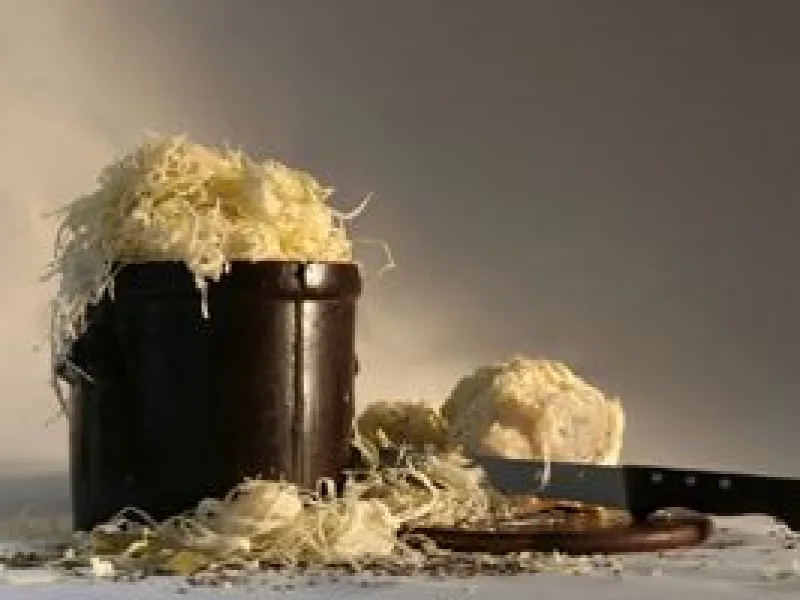
The French word 'choucroute' (for 'sauerkraut') derives from the Alsacian dialect 'sûrkrût' itself from the German 'sauerkraut'. Simpler for the English word which just adopts the original German word. 'sauer' is for 'sour' and 'kraut' is for 'grass'.
The beginnings were the sour soups, early prepared with young small branches, buds and/or leaves of birches, nettle and sorrel.
One discovered signs of pickled cabbage during the neolitic ages in the German food and in the food of numerous central European peoples. Starting XVIIIth century, the first manufactures for the 'industrialisation' of the barrels of cabbage settled in Magdeburg (Germany), then in Strasbourg (Alsace, France). Captain James Cook, in the 1770-1780s declared that its expeditions had been successful partly due to pickled cabbage. Actually, the addition of fermented cabbages into the daily food of the crews (thanks to the phosphorus, potassium and vitamins contained in them)had contributed to avoid some deficiencies and diseases due to lack of vitamins like scurvy. The British dealers of that time quickly understood its commercial interest and therefore settled wharehouses in many harbours ("the Sauer Kraut Magazins" where the expedition captains used to get their supplies before departure.
Later on, the usage of "salted herbs" allowed the first American settlers to go through rigourous winters.
We find all these old usages so called "From Old France" in the Acadian cuisine. Actually, our far cousins still preserve in salt cabbage, herbs ans mainly French pod beans they store in stoneware pots ("les croques" in Acadian French)
The beginnings were the sour soups, early prepared with young small branches, buds and/or leaves of birches, nettle and sorrel.
One discovered signs of pickled cabbage during the neolitic ages in the German food and in the food of numerous central European peoples. Starting XVIIIth century, the first manufactures for the 'industrialisation' of the barrels of cabbage settled in Magdeburg (Germany), then in Strasbourg (Alsace, France). Captain James Cook, in the 1770-1780s declared that its expeditions had been successful partly due to pickled cabbage. Actually, the addition of fermented cabbages into the daily food of the crews (thanks to the phosphorus, potassium and vitamins contained in them)had contributed to avoid some deficiencies and diseases due to lack of vitamins like scurvy. The British dealers of that time quickly understood its commercial interest and therefore settled wharehouses in many harbours ("the Sauer Kraut Magazins" where the expedition captains used to get their supplies before departure.
Later on, the usage of "salted herbs" allowed the first American settlers to go through rigourous winters.
We find all these old usages so called "From Old France" in the Acadian cuisine. Actually, our far cousins still preserve in salt cabbage, herbs ans mainly French pod beans they store in stoneware pots ("les croques" in Acadian French)

How to make your pickled cabbage.
Quite easy ; you will find below many ways to make eat it. Then why, you epicurian men and women wouldn't you try the experiment and prepare our own home made pickled cabbage ?
The most appropriate cabbage variety is the (in French language) the 'quintal d'Alsace' ('quintal' means litterally 'one hundred kilogrammes' which illustrates that this variety of cabbage is quite big !) - I could not find, if available - the English equivalent.
Preparation :
keep aside 2 large nice leaves of your cabbage, then take away its stalk (throw it) and slice thinly the cabbage (if you find one, you can use a special grater). Wash it and put a 10 centimeter - 4 inch - thick layer of it at bottom of a high container, then put a layer of coarse salt and a few juniper berries spread in it. Pack it well a uniform way so that a salty juice starts to go out and up on top. Repeat the whole sequence. The last layer must be completely covered by the salted juice produced by the successive pressure. Finally, cover with the 2 leaves put aside (see above)and then cover with a wooden lid slightly smaller than your container. Put an heavy weight on top.
The following day, because of the pressure, water will cover the lid ; you can take away a part of it but the lid must always be totally under water. Keep your container in a cool place for at leat one month. When froth is no longer produced, then the pickled cabbage is ready for consumption and you can keep it for several months like that. You can then substitute fresh clean water to the salted liquid.
The first time you will open the container, don't be surprised by the strong unpleasant and agreesive smell : it results from the fermentation of the cabbage and this is normal. Do not forget to rince your pickled cabbage before using it for cooking.
When you want to take some cabbage out of the contained, first take away some liquid from the top, and after cover again the cabbage with the 2 leaves, rince the wooden lid with warm hot before puting it back on the cabbage leaves and do not forget the heavy weight. Always cover with fresh clean water.
In the past, people used to like picked cabbage having lasted for a long time in the brine (and so having become yellowish) : the taste of the consumers has changed and they now prefer crunchy cabbage, i.e. having staid a shorter time in the brine.
Hansi, THE great Alsacian drawer said the following : " pickled cabbage must always been meticulously simmered, patience and long lasting are the secret of it and this is why sauerkraut is a sunday dish".
Sometimes, reading old ccoking books, the unexpected comes. For instance, we can read that until the 20th century, some families were still serving sauerkraut together with mashed split peas.
Quite easy ; you will find below many ways to make eat it. Then why, you epicurian men and women wouldn't you try the experiment and prepare our own home made pickled cabbage ?
The most appropriate cabbage variety is the (in French language) the 'quintal d'Alsace' ('quintal' means litterally 'one hundred kilogrammes' which illustrates that this variety of cabbage is quite big !) - I could not find, if available - the English equivalent.
Preparation :
keep aside 2 large nice leaves of your cabbage, then take away its stalk (throw it) and slice thinly the cabbage (if you find one, you can use a special grater). Wash it and put a 10 centimeter - 4 inch - thick layer of it at bottom of a high container, then put a layer of coarse salt and a few juniper berries spread in it. Pack it well a uniform way so that a salty juice starts to go out and up on top. Repeat the whole sequence. The last layer must be completely covered by the salted juice produced by the successive pressure. Finally, cover with the 2 leaves put aside (see above)and then cover with a wooden lid slightly smaller than your container. Put an heavy weight on top.
The following day, because of the pressure, water will cover the lid ; you can take away a part of it but the lid must always be totally under water. Keep your container in a cool place for at leat one month. When froth is no longer produced, then the pickled cabbage is ready for consumption and you can keep it for several months like that. You can then substitute fresh clean water to the salted liquid.
The first time you will open the container, don't be surprised by the strong unpleasant and agreesive smell : it results from the fermentation of the cabbage and this is normal. Do not forget to rince your pickled cabbage before using it for cooking.
When you want to take some cabbage out of the contained, first take away some liquid from the top, and after cover again the cabbage with the 2 leaves, rince the wooden lid with warm hot before puting it back on the cabbage leaves and do not forget the heavy weight. Always cover with fresh clean water.
In the past, people used to like picked cabbage having lasted for a long time in the brine (and so having become yellowish) : the taste of the consumers has changed and they now prefer crunchy cabbage, i.e. having staid a shorter time in the brine.
Hansi, THE great Alsacian drawer said the following : " pickled cabbage must always been meticulously simmered, patience and long lasting are the secret of it and this is why sauerkraut is a sunday dish".
Sometimes, reading old ccoking books, the unexpected comes. For instance, we can read that until the 20th century, some families were still serving sauerkraut together with mashed split peas.
How to cook sauerkraut:
Find below the "sauerkraut of Colmar housekeepers recipe" (Colmar is a very old city of Alsace), one of the oldest ones to day.
Proportions for 6 people
In a pot going into the oven, gently bake with no colour 2 thinly sliced onions in 50 grams (1.5 onces) of goose fat so that it makes a layer on bottom of the pot then pour alayer of 500 grams (1 'big' pound) of raw pickled cabbage, add salt (not much) and peper and let it gently bake covered with the pot lid during 15 minutes. Then add 15 centiliters (1 cubic inch) of Sylvaner wine (dry white Alsacian wine, a raw apple cut in large segments and a few juniper berries that you have wrapped in a thin white cloth. Then pour beef stock to cover the cabbage and cook it in the oven at a temperature of 170° celsius (338°F)during 3 hours but after the first 2 hours, add a piece (1 kilogramme = 2.2 pounds approx.)of smoked steaky bacon and 15 minutes before the end of the total 3 hours, pour 5 centiliters (1/3 of the quantity of the wine you added) of 'kirsch' (dry white cherry brandy).
Presentation :
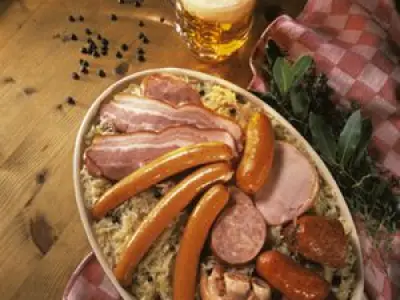
the sauerkraut is presented "crowned" by the steaky bacon sliced, roasted pork ribs ans small sausages (knackis type)and boiled (with their skin)peeled potatoes around the whole. Some purits say that the "real" sauerkrut is served with the 3 sacred sausages (Frankfurt, Strasbourg and Montbéliard).
Other purists, settled on the other bank of the Rhin river (i.e. in Germany)request the addition of fried oysters !...
And now, sauerkrut "from the sea".
It has been made popular by the famous "restaurant Baumann" in Paris in the 1970s and are still very popular.
The only difference with the above detailed recipe is that no fat (goose or pork fat or even steaky bacon) is added ; we moisten with a large glass of Sylvaner wine plus, up to the level of the cabbage with a good chicken custard base before going into the oven.
An infinite number of combination of sea food ingredients is possible ; smoked fish (halibut, salmon, haddock) but also some delicate fish like monk fish or turbot sections, dover sole filets. You can also try scallops or queen scallops. Insert them into the pickled cabbage and let them cook in accordance with the thickness and the texture of the fish (15 minutes for a monk fish segment, 10 minutes for sole filets,... You can serve the dish with a "beurre blanc" (in French) butter with white wine and shalots sauce in a separate sauce pan.
The interest of pickled cabbbage is that such cooked cabbage can be served as vegetables for numerous basis like roasted goose or duck, pheasant, young partridge, but also snails, fried eggs, sausages or black sausage, andouillettes, poultry quenelles ... And what about a pan fried pikeperch or an escalope of fresh salmon or of goose liver just pan fried.
We can also make delicious soups and even sauerkraut covered with grated cheese and gratinated.
And now 2 recipes you can find on our site :
-> the alsacian sauerkraut
-> the alsacian thick round of pork in sauerkraut
And for the ending :2 original sauerkraut recipes
1) The pickled cabbage salad
Wash several times your raw pickled cabbage, moisten it to just cover it and let it cook during 15 minutes. Rince it thoroughly and let it cool down.
Make a mayonnaise with mustard and a bit of grated horseradisch.
Add the cabbage, stir and add small cubes of sausages (Lyon or Morteaux - I am not sure one can find an appropriate transalation ?) plus some thin slices of saveloy.
A pure delight.
2) Pickled cabbage with chestnuts
In cooked pickled cabbage, add skinned and baked chestnuts and some segments or raw apple : the combination of cabbage and chestnut is just divine !
At last, I am fully aware that I only lightly touched this mytical recipe and that each county of the East (Alsace) has its own geniune one. I so invite all of you to use these pages of recipe proposals in order to deapen even more the level of our knowledge and of culinary share.
Find below the "sauerkraut of Colmar housekeepers recipe" (Colmar is a very old city of Alsace), one of the oldest ones to day.
Proportions for 6 people
In a pot going into the oven, gently bake with no colour 2 thinly sliced onions in 50 grams (1.5 onces) of goose fat so that it makes a layer on bottom of the pot then pour alayer of 500 grams (1 'big' pound) of raw pickled cabbage, add salt (not much) and peper and let it gently bake covered with the pot lid during 15 minutes. Then add 15 centiliters (1 cubic inch) of Sylvaner wine (dry white Alsacian wine, a raw apple cut in large segments and a few juniper berries that you have wrapped in a thin white cloth. Then pour beef stock to cover the cabbage and cook it in the oven at a temperature of 170° celsius (338°F)during 3 hours but after the first 2 hours, add a piece (1 kilogramme = 2.2 pounds approx.)of smoked steaky bacon and 15 minutes before the end of the total 3 hours, pour 5 centiliters (1/3 of the quantity of the wine you added) of 'kirsch' (dry white cherry brandy).
Presentation :
the sauerkraut is presented "crowned" by the steaky bacon sliced, roasted pork ribs ans small sausages (knackis type)and boiled (with their skin)peeled potatoes around the whole. Some purits say that the "real" sauerkrut is served with the 3 sacred sausages (Frankfurt, Strasbourg and Montbéliard).
Other purists, settled on the other bank of the Rhin river (i.e. in Germany)request the addition of fried oysters !...
And now, sauerkrut "from the sea".
It has been made popular by the famous "restaurant Baumann" in Paris in the 1970s and are still very popular.
The only difference with the above detailed recipe is that no fat (goose or pork fat or even steaky bacon) is added ; we moisten with a large glass of Sylvaner wine plus, up to the level of the cabbage with a good chicken custard base before going into the oven.
An infinite number of combination of sea food ingredients is possible ; smoked fish (halibut, salmon, haddock) but also some delicate fish like monk fish or turbot sections, dover sole filets. You can also try scallops or queen scallops. Insert them into the pickled cabbage and let them cook in accordance with the thickness and the texture of the fish (15 minutes for a monk fish segment, 10 minutes for sole filets,... You can serve the dish with a "beurre blanc" (in French) butter with white wine and shalots sauce in a separate sauce pan.
The interest of pickled cabbbage is that such cooked cabbage can be served as vegetables for numerous basis like roasted goose or duck, pheasant, young partridge, but also snails, fried eggs, sausages or black sausage, andouillettes, poultry quenelles ... And what about a pan fried pikeperch or an escalope of fresh salmon or of goose liver just pan fried.
We can also make delicious soups and even sauerkraut covered with grated cheese and gratinated.
And now 2 recipes you can find on our site :
-> the alsacian sauerkraut
-> the alsacian thick round of pork in sauerkraut
And for the ending :2 original sauerkraut recipes
1) The pickled cabbage salad
Wash several times your raw pickled cabbage, moisten it to just cover it and let it cook during 15 minutes. Rince it thoroughly and let it cool down.
Make a mayonnaise with mustard and a bit of grated horseradisch.
Add the cabbage, stir and add small cubes of sausages (Lyon or Morteaux - I am not sure one can find an appropriate transalation ?) plus some thin slices of saveloy.
A pure delight.
2) Pickled cabbage with chestnuts
In cooked pickled cabbage, add skinned and baked chestnuts and some segments or raw apple : the combination of cabbage and chestnut is just divine !
At last, I am fully aware that I only lightly touched this mytical recipe and that each county of the East (Alsace) has its own geniune one. I so invite all of you to use these pages of recipe proposals in order to deapen even more the level of our knowledge and of culinary share.
Comments (15)
Je vais dès que possible m'y mettre avec diverses idées de présentation et accompagnement présentés ici.
Essayez donc "la choucroute des ménagères" servie simplement avec une belle viande rouge grillée (à la place des pommes frites par exemple)c'est un vrai régal !
C'est ça la cuisine alsacienne à l'ancienne. Try it, you sure will like it.
J'ignore dans quel pays vous résidez (renseignez-nous) mais j'imagine qu'il y ait plus facile de se procurer de l'huile que de la graisse de palmipède ... Dans ces conditions, vous avez sans doute raison dans la cadre d'une première sensibilisation.
Je comprends aussi à votre dernier message que vous êtes un gourmand (ce que je ne peux décemment pas critiquer... La vraie purée (il y en a-t-il une autre car cette "chose" lyophilisée à réhydrater devrait porter un autre vocable)est évidemment plus moêlleuse qu'une pomme de terre nature : je vous promets d'essayer un jour de frimas, après avoir desséré quelques crans de ma ceinture. Et pourquoi ne pas remplacer le beurre dans la purée par de graisse d'oie pour rester dans le ton et limiter le dégât sur les artères ? je ne parle pas du chou, diététique mais de la charcuterie fumée.
Amicalement
PS - vous savez, je n'ai pas besoin de patience pour parler 'cuisine' et cette communication est un plaisir
Encore moi. J'ai oublié un détail.
Comparaison faite pommes de terre en robe des champs et purée de pommes de terre. Biên entendu que les pommes de terre en robe des champs sont parfaitement adaptées à ce plat onctueux. Mais essayez avec la purée, une vraie purée, une purée grand'mère pas de la mousseline.
Vous n'êtes pas sans savoir que dans la purée on y met du lait, du beurre et pour certain un jaune d'oeuf.
Une fois sur la langue avec de la choucroute ... donnez moi votre appréciation. Affaire de goût et de jeu gustatif.
Merci pour votre patience.
Michel
Merci pour votre commentaire à mon adresse et j'accepte très volontier toutes vos observations qui sont parfaitement vraies.
Je suis aussi "un évolutif" hors de mon terroir puisque je réside dans un autre pays et que je fais connaître notre bonne cuisine française à mes amis et à mon entourage tout en l'adaptant d'une manière évolutive pour la familiariser aux papilles de mes invités. D'autant plus qu'ici on ne connait pas la choucroute !Aussi mes propos précédents ne s'adressaient pas particulièrement à des connaisseurs comme vous et moi mais tout simplement à ceux et à celles qui n'ont jamais fait de choucroute, personnes qu'il faut particulièrement encourager à "tâter" le plat.
Mon cher Dubarry lorsque j'ai fait mon premier cassoulet à la lecture et au mot à mot d'une recette, mon chat n'en aurait pas voulu. Et pourtant j'adore le Sud Ouest. Heureusement aujourd'hui après plusieurs essais progressifs mon cassoulet ne déshonore pas cette région.
Avec toutes mes amitiés et va pour la graisse d'oie.
Michel
la choucroute que maman faisait et que j'ai gardé :on tapisse le fond de la cocotte qui va au four,d'une large couenne de jambon cru 1/2 cm d'épaisseur puis le genièvre, le laurier etc,une couche de choucroute,une saucisse montbéliard par personne,une couche de choucroute,une couche de tranchettes de poitrine fumée,une couche de choucroute,un jarrotin par personne,une couche de choucroute,graisse d'oie,bouillon de boeuf,et sylvaner .ce qu'il faut de sel, poivre , même temps de cuisson que votre recette .
jusque là,toutle monde s'est léché les 4 doigts et le pouce comme on dit dans notre berry . donc à vous d'eesayer . jeanine.
Je suis comme vous profondément respectueux des terroirs mais je pense aussi qu'une cuisine, tout comme une langue, ne peut rester vivante que si elle accepte d'évoluer et d'absorber des apports extérieurs (de façon maîtrisée bien entendu). Beaucoup de purs plats de terroir se sont construits ou transformés sur des ingrédients 'exotiques' : par exemple, que seraient la cuisine provençale sans la tomate apportée des Andes par les Espagnols, le cassoulet sans les haricots également d'origine américaine,les foies gras de Gascogne et d'Alsace, dont la tradition et le savoir faire a suivi l'exode des Juifs de la vallée du Nil et du Proche Orient, les pruneaux d'Agen sans les prunes de Damas apportées par les Croisés etc... L'huile pour la choucroute, indépendamment du problème gustatif, vous parait-elle mieux respecter la pureté du terroir alsacien que la graisse d'oie (ou de canard, très facile à trouver de surcroit)?
Ne voyez aucune polémique excessive dans mes commentaires mais juste une invitation au débat.
J'oubliais : les pommes de terres en robe des champs autour de la choucroute me semblent déjà destinées à apporter du moêlleux et de la douceur en double cointrepoint au chou non ?.
ne vous inquietez pas ce n'est que l'usine qui est placée dans le département de l'Aube
la choucroute n'a d'origines que dans les départements de l'est ainsi qu'outre rhin
Dormez en paix pour vos acquits régionaux et bon appétit
chef patrick
Aussi avec les grains de genièvre j'ajoute 1 ou 2 feuille de laurier. Quant à la graisse d'oie, ne vous affolez pas. De l'huile ordinaire fera tout aussi bien l'affaire.
Mais le chef Patrick a bien décrit l'ensemble et les différentes approches principales de l'usage de la choucroute. Je noterais à son intention un tout petit détail concernant la purée de pois cassés en accompagnement. Sachez que l'on sert aujourd'hui encore tant en Alsace qu'outre Rhin et ailleurs en pays plus à l'est, de la purée de pommes de terre avec la choucroute. Un délice car la purée atténue l'amertume du chou fermenté (même bien lavé au préalable).
Quant aux choucroutes de la mer : non merci! - Je suis un bon vieux puriste du terroir alsacien.
Amicalement vôtre.
Michel G.J.
Leave a comment