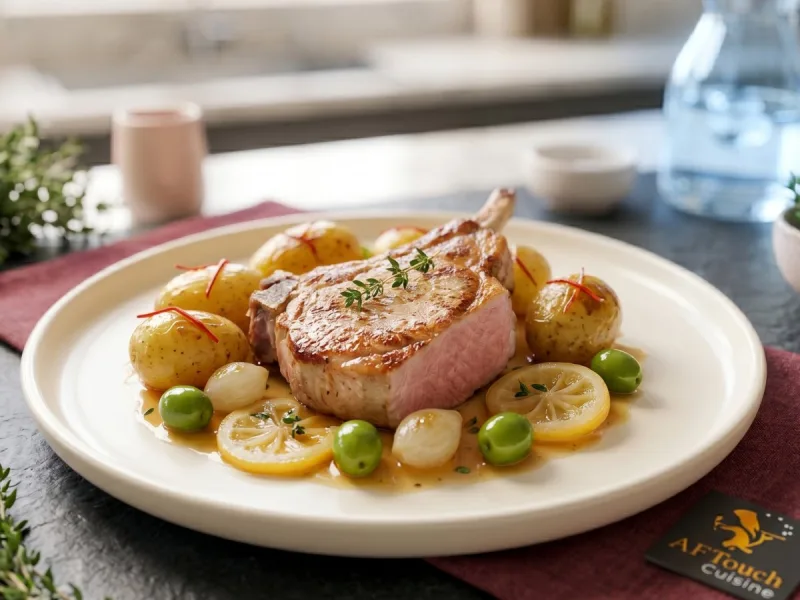
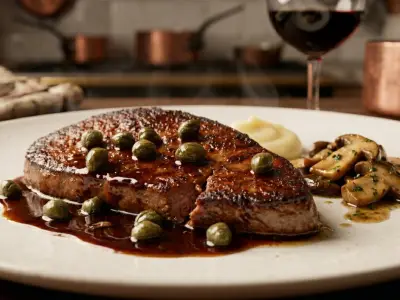
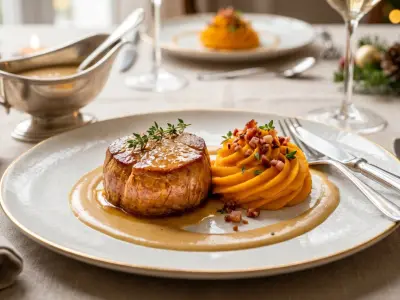
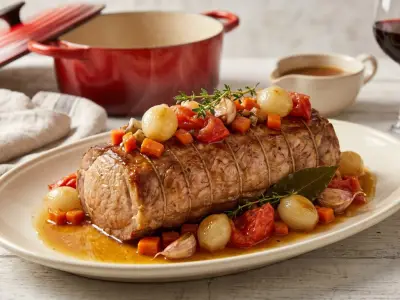
Free-Range Veal Chop with Preserved Lemons & Olives tender and fragrant
Ingredients for 4 servings
- 4 beautiful free-range veal chops, about 7 oz (200 g) each (if you can find them "milk-fed", even better)
- 16 small new potatoes (Jersey Royals or Charlotte potatoes work well)
- 1 preserved lemon from Menton, pulp removed and sliced into 12 thin slices
- 1 juice of untreated Menton lemon
- A few threads of preserved red pepper
- 12 small spring onions
- 16 pitted green olives (Picholine)
- Thyme, preferably lemon thyme, and bay leaf
- Sea salt, fine salt and white pepper from the mill
- Olive oil and good quality butter
- It's best to prepare this dish 2 hours in advance to allow your veal chops to rest properly
Step-by-step recipe
1 In a heavy-bottomed pan, melt a generous knob of butter. When it starts to brown, place your seasoned veal chops with a pinch of thyme flowers. Surround them with the spring onions. Cook gently for 6 minutes on each side, then pour in your lemon juice and 0.4 cup (10 cl) of water or veal stock. Season lightly with salt and pepper. Bring to a quick boil, then turn off the heat and cover with the tightest-fitting lid you have.
2 In a saucepan, place your potatoes, just wiped dry. Add thyme and 2 bay leaves. Season with sea salt or cook plain in sea water. Cover with water to submerge them completely. Cook gently until you can easily pierce them with the tip of a knife (15 to 20 minutes).
3 Drain them, and when they're cool enough to handle, make a small slit in each one and insert your red pepper threads. In a small cocotte, roast them in a little olive oil and a knob of butter. Season with salt, cover and turn off the heat.
4 Now you're about 10 minutes away from eating. Reheat your veal chops, remove them and keep warm. Reduce the cooking liquid by half. Add the preserved lemons and olives. Taste and adjust the seasoning. At the same time, warm through your potatoes.
5 Plating: On hot plates, place the veal chops in the center, arrange the potatoes around them, and pour the hot jus with onions, preserved lemons and olives scattered over.

Chef Patrick's Comment
I've already told you the story of the lemon many times before, but in this full season, allow me to tell you about one of our great regional treasures: the Menton lemon.
A bit of history then. Its traces can be found as far back as the 17th century, when Menton was part of the Principality of Monaco. Prince Louis I went so far as to appoint a magistrate responsible for regulating its harvesting and commerce, proof of the importance already placed on it. During this period, citrus farming was the main economic activity of the town, with annual production estimated between 9,000 and 10,000 tonnes.
Sadly, from the second half of the 19th century, terrible plagues struck the orchards: first "Mal Secco", then the devastating frost of 1956, which decimated nearly all the plantings. Today, the harvest barely reaches 50 tonnes.
To claim the IGP designation, the specifications are strict:
- The lemon must be grown in the orchards of the municipalities of Menton, Roquebrune-Cap-Martin, Castellar and Gorbio.
- Lemon trees must be spaced at least 4 metres apart.
- Fruits must ripen on the tree, be picked by hand and undergo no treatment after harvest.
It is only after passing through approved packing stations that our beautiful lemons obtain the "Menton IGP" designation. All fruits that do not meet these specifications are marketed under the name "Country Lemons".
If I'm offering you this recipe today, it's first because I have a genuine passion for this fruit, whose tangy flavour pairs beautifully with a wide variety of dishes. And it happens that my guests share this enthusiasm entirely.
Wine Pairing
Explore all French wines ›Comments (0)
No comments yet. Be the first to share your experience!
Help other cooks
Share a tip, your adaptation, your result. Every comment counts.