
Asparagus
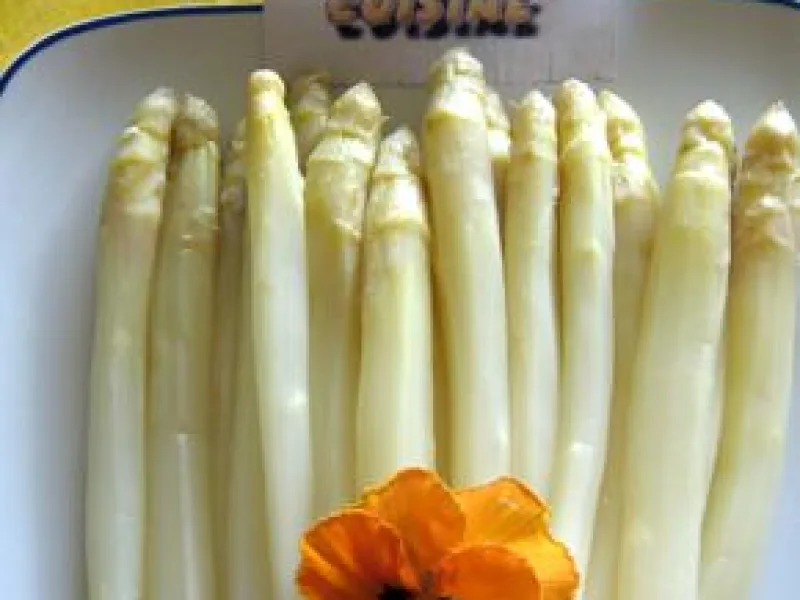
Asparagus is a latin word.
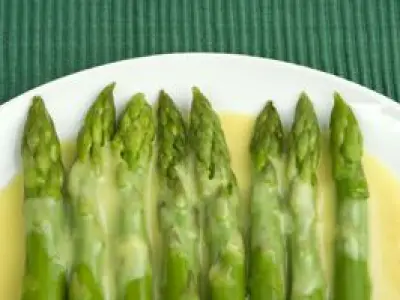
Asparagus had been first appreciated by the ancient Egyptians, Greeks and Romans. They then suddenly disappeared from the tables during the Middle Age (note of the translator : may be because of the power of the catholic religion : refer tho the shape of asparagus ...) and came back much latter in France during the seventeenth century thanks to Louis XIV who made asparagus becoming a royal court dish under the French name "esparge" (note of the translator : name no longer used, the French modern current name being "asperge"). The "Sun King" liked asparagus served warm with a creamy sauce.
They were first growned up in the King's vegetable gardens (in Versailles), then in Argenteuil (note of the translator : city close to Paris, on the river Seine and often painted by the French Impressionists, including Claude Monet). Argenteuil still remains a reference for asparagus today. Then they "expapriate" to Sologne (note of the translator : Sologne is a forest, lake and sand earth - ideal for asparagus - area in the south of Paris, also famous fore hunting) in the 1870's.
We can now find several asparagus types :
White asparagus : picked when they just come out of the earth (Alsace area)
Purple asparagus : picked when only a few centimeters have come out of the earth (Charentes and Loire areas).
Green asparagus : picked when they are 5 to 6 inches long (Lauris - Orleans area, Rhône area)
Wild asparagus : green, very thin, slightly bitter, from plain fields, rare and excellent !
How to peel fresh asparagus ?
Grate them with a vegetable peeler, from the part just below the tip to the bottom and when you are close to the bottom, do not hesitate to break them with your fingers, it will break at the appropriate level. Lay the asparagus down on a board and with a knife, cut the asparagus so that they all have the same lenght. Now you make small bunches of asparagus and you tie them up with a thin culinary string.
How to cook asparagus ?
Several techniques but in all cases, in water salted with 10 grams (1/3 oz) salt par liter of water. You can cook them in a large sauce pan covered with a white cloth. Water steam will inflate the cloth and when asparagus are cooked, you stop the cooking and cool them down by hanging the cloth on the tap (between the tap and the asparagus so that the asparagus tips, that are fragile at this point, are protected from water directly falling down water on them and then filtered by the cloth).
You can also cook the asparagus standing up vertically into a basket into water and adding gradually water after the previous "layer" of water has cooked the lower "layer" of the asparagus : 10 minutes for the first half of the asparagus, then add water just under the tips for the second half and cook another 5 minutes then cover the tips with water and cook another 2 to 3 minues. The rationale is that the asparagus require more cooking at the inferior part and less for the tips.
You can also steam them, cook them "à la meunière" in butter, etc...
Asparagus had been first appreciated by the ancient Egyptians, Greeks and Romans. They then suddenly disappeared from the tables during the Middle Age (note of the translator : may be because of the power of the catholic religion : refer tho the shape of asparagus ...) and came back much latter in France during the seventeenth century thanks to Louis XIV who made asparagus becoming a royal court dish under the French name "esparge" (note of the translator : name no longer used, the French modern current name being "asperge"). The "Sun King" liked asparagus served warm with a creamy sauce.
They were first growned up in the King's vegetable gardens (in Versailles), then in Argenteuil (note of the translator : city close to Paris, on the river Seine and often painted by the French Impressionists, including Claude Monet). Argenteuil still remains a reference for asparagus today. Then they "expapriate" to Sologne (note of the translator : Sologne is a forest, lake and sand earth - ideal for asparagus - area in the south of Paris, also famous fore hunting) in the 1870's.
We can now find several asparagus types :
White asparagus : picked when they just come out of the earth (Alsace area)
Purple asparagus : picked when only a few centimeters have come out of the earth (Charentes and Loire areas).
Green asparagus : picked when they are 5 to 6 inches long (Lauris - Orleans area, Rhône area)
Wild asparagus : green, very thin, slightly bitter, from plain fields, rare and excellent !
How to peel fresh asparagus ?
Grate them with a vegetable peeler, from the part just below the tip to the bottom and when you are close to the bottom, do not hesitate to break them with your fingers, it will break at the appropriate level. Lay the asparagus down on a board and with a knife, cut the asparagus so that they all have the same lenght. Now you make small bunches of asparagus and you tie them up with a thin culinary string.
How to cook asparagus ?
Several techniques but in all cases, in water salted with 10 grams (1/3 oz) salt par liter of water. You can cook them in a large sauce pan covered with a white cloth. Water steam will inflate the cloth and when asparagus are cooked, you stop the cooking and cool them down by hanging the cloth on the tap (between the tap and the asparagus so that the asparagus tips, that are fragile at this point, are protected from water directly falling down water on them and then filtered by the cloth).
You can also cook the asparagus standing up vertically into a basket into water and adding gradually water after the previous "layer" of water has cooked the lower "layer" of the asparagus : 10 minutes for the first half of the asparagus, then add water just under the tips for the second half and cook another 5 minutes then cover the tips with water and cook another 2 to 3 minues. The rationale is that the asparagus require more cooking at the inferior part and less for the tips.
You can also steam them, cook them "à la meunière" in butter, etc...
How to taste/eat asparagus ?
Normally, one must eat the tip (bud of the asparagus) by cutting it from the stem/stock with folk and knife, then the remaining of stem with the fingers (so a finger bowl is necessary on the table).
Normally, one must eat the tip (bud of the asparagus) by cutting it from the stem/stock with folk and knife, then the remaining of stem with the fingers (so a finger bowl is necessary on the table).
Personally, I like white asparagus served warm with a Maltese sauce, purple asparagus with a warm vinaigrette sauce made of hazelnut oil and sherry vinegar, green asparagus cooked "à la meunière" (the Italian way i.e. spread with grated Parmesan cheese or served with a salted Chantilly flavoured with curcuma).
At last, for wild asparagus, cook them "al dente" in water and use them like fingers of breads for soft-boiled eggs : a wonder !
And I leave you imaginating the result with black or white from Alba truffles !...
A few recipes with asparagus :
>> Warm green asparagus
>> Hollandaise sauce
>> Maltese Sauce
At last, for wild asparagus, cook them "al dente" in water and use them like fingers of breads for soft-boiled eggs : a wonder !
And I leave you imaginating the result with black or white from Alba truffles !...
A few recipes with asparagus :
>> Warm green asparagus
>> Hollandaise sauce
>> Maltese Sauce
Comments (18)
Voilà
http://www.aftouch-cuisine.com/recette/--------les-buissons-d-asperges-des-bois-2183.htm
Je viens de mettre une recette "pas trop mal" sur le site avec des aspergettes lisez la cela pourra peut être vous donner des idées
a bientôt et ditesmoi
j'ai vu passer des asperges sauvages chez le maraicher, et j'aimerais bien tenter...
Pour les préparer, faut-il les éplucher ?
Le mode de cuisson est-il le même ? ou est-ce meilleur à la poele (meunière ?) comme vous le suggérez pour les asperges vertes ? Et enfin, quel temps de cuisson recommanderiez vous ?
Merci d'avance pour vos réponses !
Vous avez bien fait de la repasser au chinois nous en cuisine quelquefois on la repasse en +a l'étamine en tissu
Mais après passage au mixer j'ai dû passer ma soupe au chinois pour retirer quelques fibres d'asperges restantes non broyées et qu'il aurait été désagréable de retrouver dans la cuillère.
avec toutes mes amitiés culinaires
Stéphane
Bonne recette,
merci pour toute vos recettes agréable à lire et à faire
voici la mienne
vous gardez les pelures d'une dizaine d'asperges blanches vous les lavez puis dans une casserole vous les faites suer au beurre avec un peu d'échalote ciselée couvert 5 minutes puis vous mouillez avec 2 litres de fond de volaille préparée , a l'ébullition vous versez 80grs de riz rond
vous salez et poivrez puis vous laissez cuire 30minutes a faibles frémissements ensuite vous versez le tout dans un moulin a légumes a la grosse grille(pas de mixer)
et vous essayer en forçant un peu de passez au maximum
puis vous remettez ce coulis un peu lié sur le feu vous ajoutez 20cl de crème liquide et vous laissez réduire jusqu'à consistance d'une crème puis vous mixez (pour le volumme)vous servez avec des petits lardons a part que vous essaimerez dans votre assiette (pour la texture)
une soupe peu chère qui enchantera j'en suis sur vos convives
Bonne recette donc
Chef Patrick
Je préfère de loin les vertes sauvages.Toutefois nous avons ici, en Ariège, des producteurs qui cultivent une asperge verte onctueuse et très goûteuse. la Cuisson 3mn à l'eau bouillante. Pour ma part je n'achète que des "pointes". Je les coupe en rondelles (en conservant les pointes entières) puis je les fais cuire à la poele avec une bonne cuillère à café d'huile d'olive, du sel, et un demi verre d'eau, et cela à l'étouffé, jusqu'à ce qu'elles soient "transparentes". Cette base me sert pour faire des flans, quiches ou oeufs brouillés aux asperges.
1. Cuire les asperges à votre convenance.
2. Par personne :
>1 oeuf cuit dur-moelleux chaud,
>30 grammes de beurre (clarifié c'est mieux) fondu et chaud.
> persil et ciboulette haché.
> fleur de sel et poivre du moulin et quelques gouttes de tabasco.
> éventuellement quelques très fines lanières de jambon cru ibérique de qualité.
Passez les oeufs à la moulinette ou écrasez les grossièrement à la fourchette et ajoutez les herbes et épices.
Versez cette sauce chaude-tiède sur les asperges chaude.
Et garnir avec les fines lanières de jambon cru espagnol.
Un vrai délice.
Vous l'avez perfectionnée en trois étapes, mais de même durée en définitive.
Je pense que les temps de cuisson varient sensiblement selon le degré hydrotimétrique de l'eau.
Pour maîtriser les temps de cuisson je récupère soigneusement l'eau du climatiseur de cave.
Rien de mieux pour les mojhettes, les viandes à cuisson lente et longue, etc.
cette cuisson est pour les grosses asperges blanches pour les vertes votre temps de cuisson est exact
poutous
chef Patrick
Leave a comment